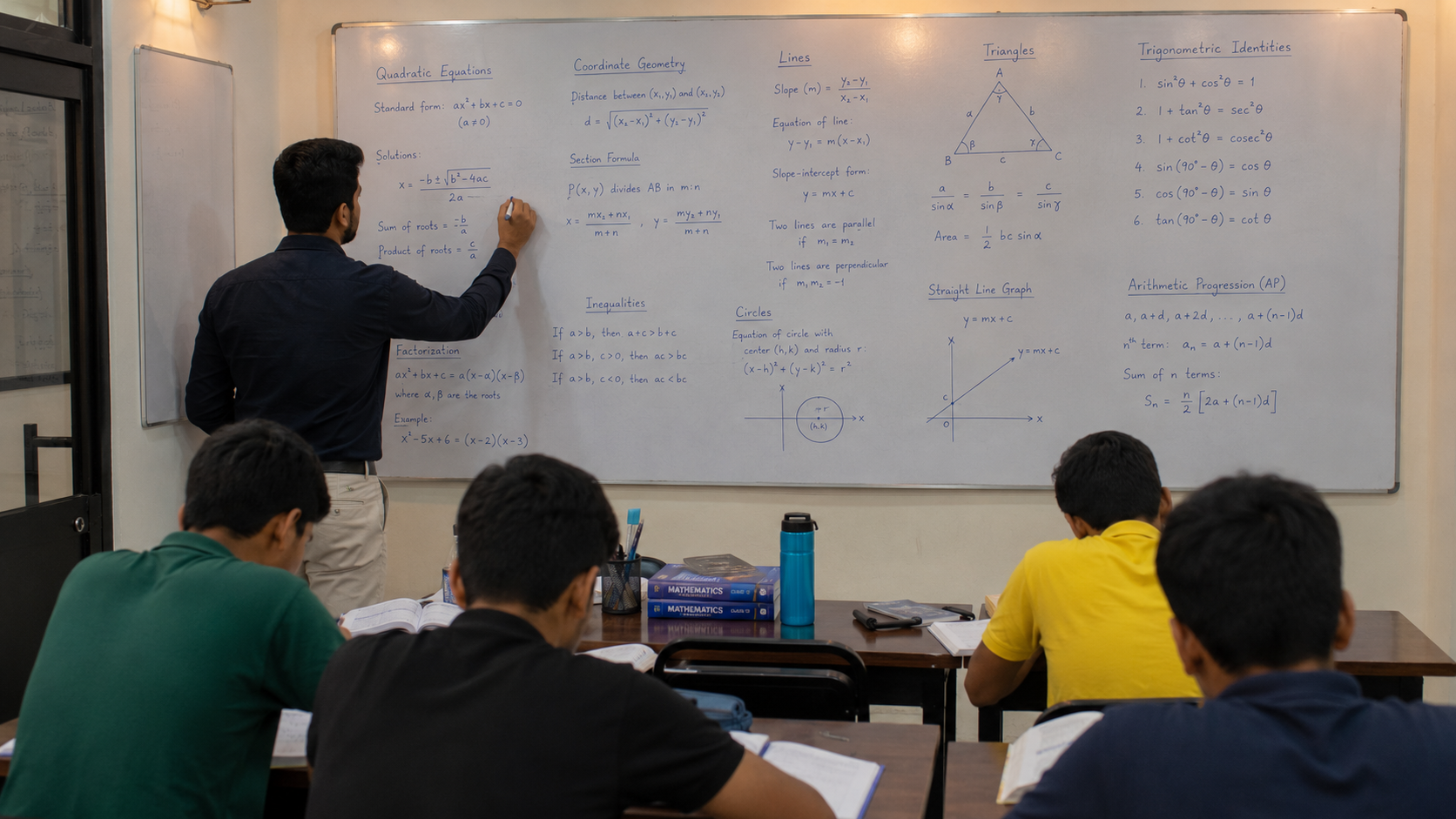
The confusion between Applied Mathematics and Standard Mathematics in Class 11 Commerce is widespread. Many students and parents assume they are the same subject at different difficulty levels — they are not. They are different CBSE papers with different syllabi, different board exams, and different implications for college admissions. This guide clarifies both, subject by subject.
What Applied Mathematics Actually Covers
Applied Mathematics (subject code 241) was introduced by CBSE specifically for non-Science stream students. The Class 11 syllabus is structured around practical and financial applications of mathematics:
- Numbers, Quantification & Numerical Applications: Number systems, binary operations, mensuration, averages, ratios — directly useful in Accountancy and business contexts
- Algebra: Sets, relations, functions, sequences and series
- Mathematical Reasoning: Statements, connectives, logical operators
- Calculus: Limits and differentiation (applications — not pure theory)
- Probability: Random experiments, events, conditional probability
- Descriptive Statistics: Mean, variance, standard deviation, skewness
- Financial Mathematics: Simple and compound interest, EMI, annuities, depreciation — the most directly Commerce-relevant unit
- Linear Programming: Graphical method, formulation of problems
What Standard Mathematics Covers
Standard Mathematics (subject code 041) is the full CBSE Mathematics syllabus shared by Science and Commerce students who opt for it. Class 11 Standard Maths covers:
- Sets, Relations and Functions
- Trigonometric Functions
- Complex Numbers and Quadratic Equations
- Linear Inequalities and Permutations & Combinations
- Binomial Theorem, Sequences and Series
- Straight Lines and Conic Sections (Circles, Parabola, Ellipse, Hyperbola)
- Introduction to Three-dimensional Geometry
- Limits and Derivatives
- Statistics and Probability
Difficulty and Preparation Comparison
Who should choose Applied Mathematics
- Students who found Class 10 Maths manageable (scored 55–80) but do not plan a heavy quantitative career
- Students targeting CA Foundation, B.Com (H), BBA, or CUET general test preparation
- Students whose primary effort will go into Accountancy, Business Studies, and Economics — Applied Maths supports these without dominating study time
- Students who want a Maths paper on their certificate for degree course eligibility
Who should choose Standard Mathematics
- Students with strong Class 10 Maths performance (75+) who plan to take entrance exams with heavy quant sections (CAT, specific IIM BBA exams)
- Students who might consider switching to an Engineering entrance later (unlikely but possible)
- Students specifically targeting colleges or courses that explicitly require Standard Mathematics
Career and Admissions Implications
The admissions landscape in 2026 has evolved such that the gap between Applied Maths and Standard Maths in terms of college eligibility is smaller than it was five years ago. Key points:
- CUET general test: Both prepare you reasonably well for the quantitative aptitude section — Applied Maths may actually be better aligned to CUET's question style
- B.Com (H) at DU: Applied Mathematics is accepted at most colleges for eligibility. Verify individual college requirements at the time of applying.
- CA Foundation: Applied Maths prepares you well for Business Mathematics and Statistics papers
- Economics Honours: Some colleges prefer Standard Maths, though this is not universal. Applied Maths is accepted at many
- Engineering entrances (JEE): Not possible without Standard Maths through Class 12
The Mistake to Avoid
The most common error is choosing Standard Mathematics because "it sounds better" or because a parent believes it keeps more options open — without accounting for the preparation cost. Standard Mathematics requires significantly more study time than Applied Mathematics. A Commerce student who spends excessive time on Standard Maths topics (trigonometry, complex numbers, conic sections) that have no Commerce career relevance risks their performance in Accountancy and Economics — the subjects that actually drive their board score and career foundation.
Frequently Asked Questions
Found this useful? Share it.