Class 12 CBSE Commerce boards are straightforward in one sense — the entire syllabus is prescribed, the question pattern is fixed, and previous year papers give a reliable preview of what will come. The difficulty is not unpredictability; it is volume and time pressure. This guide outlines a practical preparation strategy for each subject that Dwarka students can follow.
Accountancy: Where the Most Marks Are
Accountancy is typically worth the most to students who prepare correctly — the marks are achievable and structured. A student who has done consistent practice can score 75+ out of 80. The structure of the Class 12 Accountancy board paper:
- Part A: Partnership Accounts (~60 marks) — Partnership fundamentals, goodwill valuation, reconstitution (admission, retirement, death), dissolution
- Part B: Company Accounts and Analysis (~20 marks) — Share capital, debentures, financial statement analysis (ratios), cash flow statement
Where to spend your revision time
Reconstitution gets 65–70% of your Accountancy preparation time. Not because other chapters do not matter, but because reconstitution is where most students lose marks — and where the most marks are available. The sequencing rule for every reconstitution question is: calculate the new ratio and sacrificing/gaining ratio → value goodwill → pass goodwill adjustment entries → prepare revaluation account → distribute reserves and accumulated profits → adjust capital accounts. Any step out of sequence produces wrong answers downstream even if the arithmetic is correct.
Business Studies: Converting Reading Into Board Marks
BST is often underestimated in preparation time allocation and overestimated in perceived difficulty. Students who have read the textbook consistently find that the actual challenge is not the content — it is the answer format.
CBSE BST marking is format-dependent. A 4-mark question expects: concept identification + link to the case/stimulus + definition + one additional point or example. Students who dump everything they know about a topic without following this structure consistently lose 1–2 marks per question. Over a 3-hour paper with 10+ questions, this adds up to 15–20 marks.
High-priority chapters for BST boards
- Management Principles (Fayol + Taylor — compared and applied questions)
- Business Finance (financial leverage, working capital, sources of finance)
- Marketing (marketing mix, consumer rights, Maslow's hierarchy application)
- Staffing and Directing (motivation theories — Maslow and Herzberg applied to case studies)
- Controlling and Planning (interlinking questions)
Case study questions (worth 12 marks in the paper) require the most specific preparation. The technique: read the question first, identify the concept being tested, locate the relevant line in the passage, then write the answer in the format above. Students who attempt to answer from memory without re-reading the passage typically miss one mark per case-study sub-question.
Economics: Diagrams and Key-Word Answers
Class 12 CBSE Economics (Macro + Microeconomics) is split across two sections, and revision strategy differs for each:
Macroeconomics (National Income, Money and Banking, IS-LM basics, Government Budget, Balance of Payments)
National Income questions require clear definitions of GDP, GNP, NNP with correct formula application. Money and Banking questions frequently involve calculating money multiplier and credit creation. Government Budget questions test deficit types — revenue deficit, fiscal deficit, primary deficit — which students often confuse. The formula distinctions must be memorised precisely.
Microeconomics (Consumer Behaviour, Producer Behaviour, Forms of Market)
Diagrams carry marks in Micro. PPC, indifference curves, demand and supply shifts, cost curves, and market equilibrium diagrams must be drawn with correct labelling. Students who describe the diagram in words without drawing it lose the diagram marks. Students who draw a correct diagram without labelling axes and curves lose labelling marks.
Applied Mathematics: Scoring Predictably
Applied Mathematics (subject code 241) is one of the most predictable board papers in the Commerce stream — the question types repeat consistently across years. For board preparation, the approach is straightforward: classify all previous year questions by chapter, identify which question types appear every year, and practice those types to full competency.
High-frequency Applied Maths chapters for boards: Linear programming (graphical method), EMI and annuity calculations, probability (conditional probability, Bayes' theorem), index numbers, moving averages, and basic calculus applications. Students who have practiced 3–4 questions of each type from previous year papers typically find the board paper familiar and manageable.
Preparation Timeline for Dwarka Students
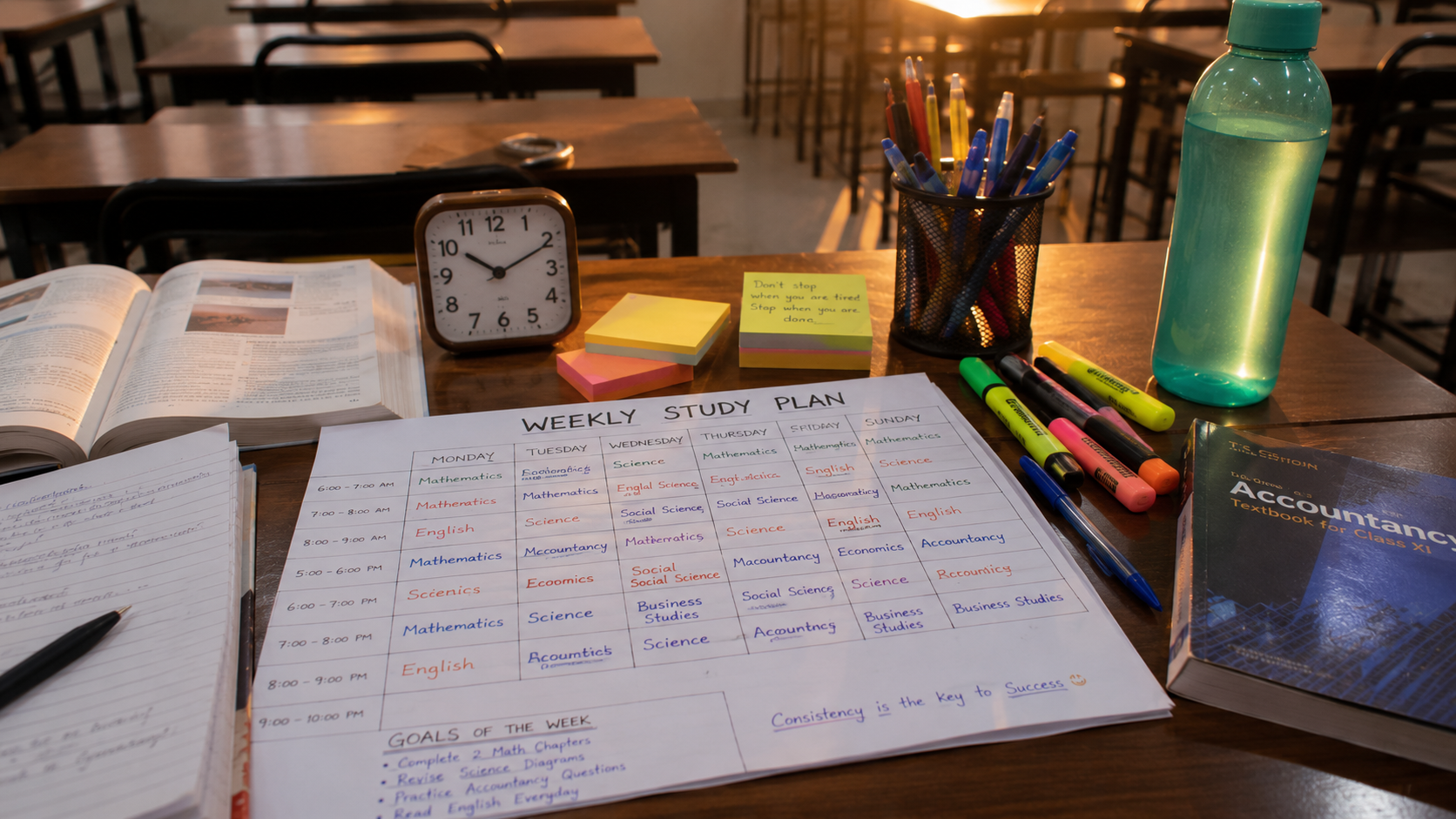
- April–August (Class 12): Complete syllabus with coaching. Don't wait for school to cover chapters — stay current in all subjects.
- September–October: First round of chapter-wise revision. Practice NCERT examples and previous year chapter questions for Accountancy and Applied Maths.
- November: Mock test cycle begins — full 3-hour subject papers under timed conditions. Identify weak areas from marks, not from reading.
- December–January: Targeted revision of weak chapters. Full previous year paper solving for BST and Economics. Accountancy: partnership reconstitution daily practice.
- February (pre-board month): Pre-board exam, post-pre-board correction, final revision on error patterns.
- Board month: No new topics. Only consolidation, formula review, and format practice.
Frequently Asked Questions
Found this useful? Share it.