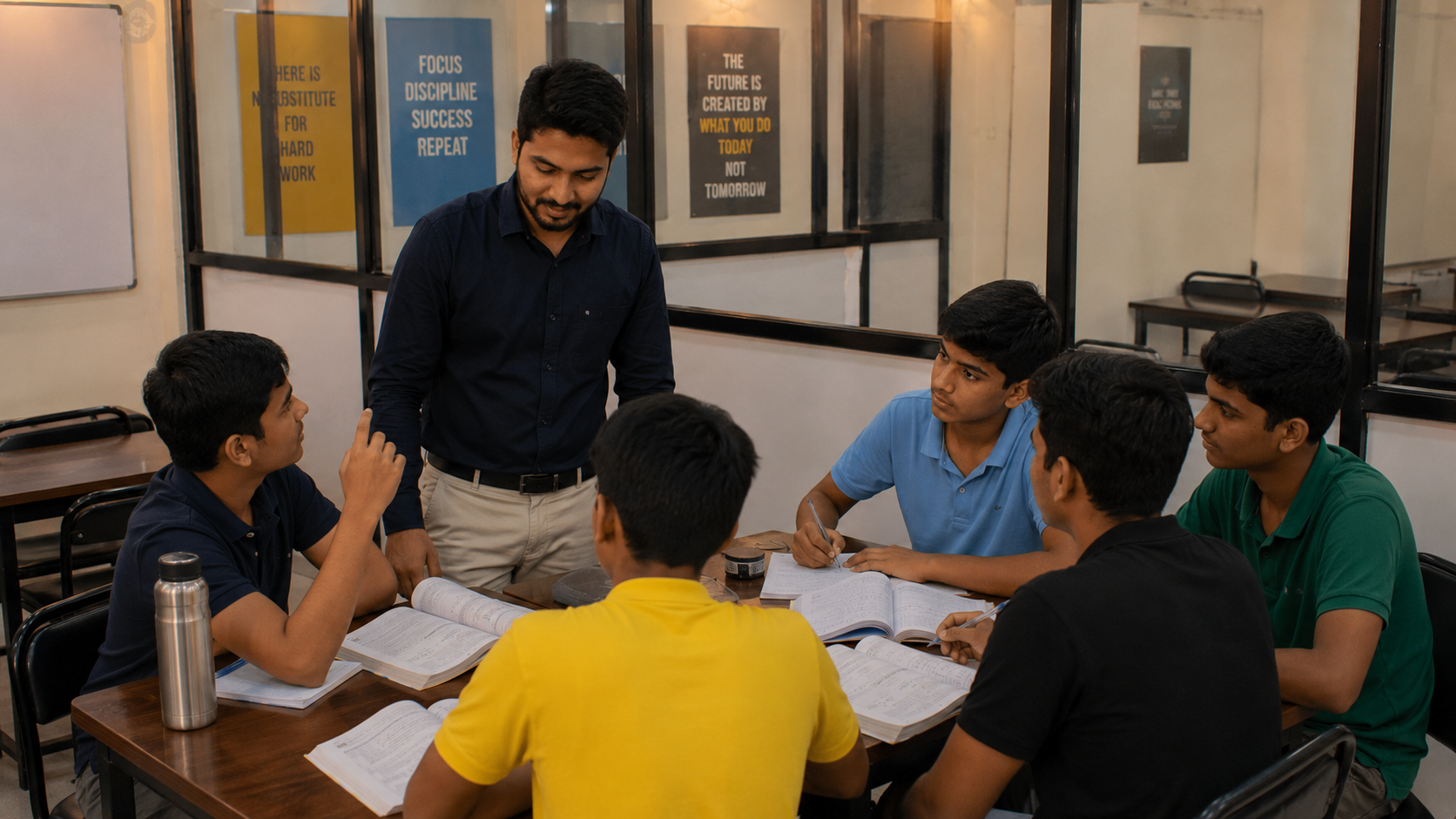
Every March and April in Dwarka, Class 10 students face one of the more consequential decisions of their academic lives: which stream to choose for Class 11 and 12. The decision is made with incomplete information, under peer pressure, and often with significant family opinion in the mix. This comparison is an attempt to give you accurate information — not to tell you which stream is better, but to describe what each actually involves.
What Commerce and Science Actually Involve
The single most useful thing a student can do before choosing a stream is understand concretely what subjects they will be studying for two years. Here is a direct comparison:
| Dimension | Commerce (Class 11–12) | Science — PCM (Class 11–12) |
|---|---|---|
| Core subjects | Accountancy, Business Studies, Economics, Applied/Standard Maths, English | Physics, Chemistry, Mathematics, English + optional (CS, PE, etc.) |
| Primary demand | Practice volume (Accountancy), reading and answer-format discipline (BST), concept+diagram accuracy (Economics) | Abstract mathematical reasoning, derivations, lab work, conceptual depth in physics and chemistry |
| Daily study type | Accountancy practice problems, theory reading, diagram drawing for Economics | Problem-solving sets (Maths, Physics), concept derivation, Chemistry reaction chains |
| Board exam style | Structured long-answer theory (BST, Economics), practical calculation formats (Accountancy), mixed paper (Applied Maths) | Numerical problem solving (Maths, Physics), conceptual short+long answer (Chemistry) |
| Stream-switch cost | Switching after the session starts is highly disruptive — plan for 2 years in your chosen stream | |
The Three Questions That Actually Matter
Forget "which stream has more jobs" or "which stream gets higher marks." Those are the wrong questions. The questions that lead to a good decision are:
1. What do I want to do after Class 12 — and which stream leads there?
This question settles most cases. If you want to pursue CA, CS, B.Com, BBA, MBA, Finance, or Banking — Commerce is the path. If you want to pursue Engineering, Medicine, Pure Sciences, or Research — Science is the path. The overlap area is Economics, Data Analytics, and Statistics — both streams can access these, though by different routes. If you genuinely do not know what you want to do after Class 12, that is a valid answer, and the follow-up question is: which subjects do you find more interesting to study?
2. What do I find more engaging — financial and business concepts, or physical and mathematical principles?
This is not about what you were better at in Class 10 — it is about what you find interesting to spend time on. Students who are drawn to how financial systems work, how businesses are organised, and how economies function tend to find Commerce engaging. Students who are drawn to how physical forces work, how chemical reactions happen, and how mathematical proofs are constructed tend to find Science engaging. Two years of sustained study requires some level of genuine interest.
3. How do I actually perform under sustained pressure across both types of content?
Class 10 performance gives a partial signal: strong performance in Mathematics and Science suggests PCM is feasible; consistent performance in Social Studies and English correlates with success in Commerce's theory subjects. But it is only a signal, not a prediction. Students who did poorly in Class 10 Maths but choose Applied Mathematics in Commerce often do well because Applied Maths (code 241) is a different, less abstract subject than Standard Maths.
What Each Stream Opens (and Closes)
Choosing Commerce at Class 11 does not prevent a student from accessing quantitative, analytical careers — but it does shape the route. Here is what each stream practically leads to:
After Commerce
- Professional routes: CA (Chartered Accountancy), CS (Company Secretary), CMA (Cost Management Accountancy)
- Degree routes: B.Com (H or General), Economics (H), BBA, BA Economics, Statistics
- Emerging tracks: FinTech, Business Analytics, ESG Finance, CFP (Certified Financial Planner)
- MBA pathway (2 years after any graduation, standard business track)
After Science (PCM)
- Engineering (JEE) — B.Tech across dozens of disciplines
- Economics/Finance — accessible via B.Sc. Economics, Statistics, or lateral MBA entry
- Defence — NDA and related routes require PCM
- Data Science — accessible via B.Sc. Statistics or Maths, or B.Tech Computer Science
An Honest Note on Social Pressure
In Dwarka schools — and across Delhi schools generally — there is a social perception that Science is more prestigious than Commerce. Some students choose Science for this reason alone, against their actual interests and aptitudes. This is a mistake that becomes apparent by the first unit test, when a student who has no interest in Physics is sitting with a question paper that requires conceptual understanding built over months.
Equally, some students choose Commerce simply because "it seems easier" without investigating what Accountancy actually involves — and find themselves struggling with a subject they had no preparation for because they assumed it would require less work.
The recommendation here is simple: choose based on what you want to study and where you want to go, not on what others are doing or what seems socially preferable. Both streams lead to excellent careers for students who engage with them seriously.
Frequently Asked Questions
Found this useful? Share it.