Accountancy is the subject that defines the Class 11 Commerce experience. For most students, it is completely new — there is nothing in Classes 9 or 10 that directly prepares you for the logic of double-entry bookkeeping. This novelty is both what makes Accountancy feel steep at first and what makes genuine mastery so satisfying. This guide takes you from absolute beginner to confident practitioner, chapter by chapter.
The Core Principle: Double-Entry Bookkeeping
Every concept in Class 11 Accountancy traces back to one foundational rule: every financial transaction affects two accounts equally and in opposite directions. One account is debited; another is credited. The total of all debits always equals the total of all credits.
This is not a rule to memorise — it is a logic system to understand. If a business receives cash from a customer, the Cash account increases (debit) and the Sales account increases (credit). If a business buys furniture on credit, the Furniture account increases (debit) and the Creditors account increases (credit). Every transaction, no matter how complex, follows this same lens.
Chapter Progression — What Each Chapter Builds
Class 11 Accountancy CBSE has a clear logical sequence. Each chapter adds one layer to the previous. The students who struggle are almost always those who moved to the next chapter before the current one was solid.
Chapters 1–2: Introduction and Theory Base
These chapters introduce accounting vocabulary, the three types of accounts (Personal, Real, Nominal), and the GAAP principles. They are reading-based and conceptual — study them carefully because they provide the language for everything that follows. A student who has not read Chapter 1 carefully will misclassify accounts throughout the year.
Chapter 3: Recording of Transactions
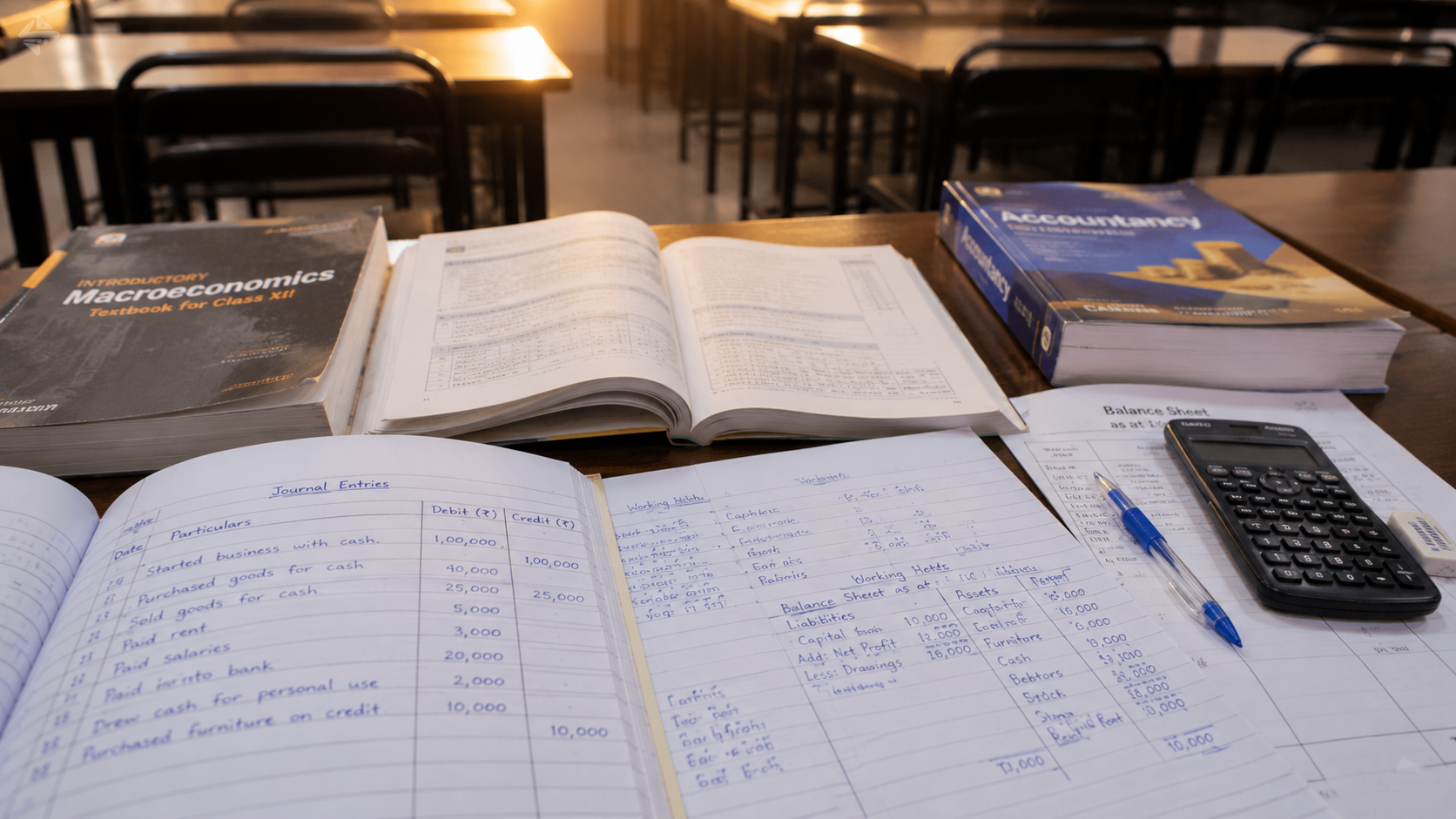
This is where Accountancy begins in practice. You learn to identify which accounts are affected, determine whether each increases or decreases, and apply the debit/credit rule. Practice is essential here — write at least 30 to 40 journal entries covering different transaction types before moving on. Do not just read the examples; write them out.
Chapter 4: Ledger
After the Journal, transactions are posted to individual Ledger accounts (the T-account format). Understand how to balance each account at period-end. Practice posting a complete set of transactions and balancing multiple accounts manually at least twice before moving to Chapter 5.
Chapters 5–7: Subsidiary Books and Cash Book
Real businesses use subsidiary books for high-volume transaction types: Purchase Book, Sales Book, Returns Books, and the Cash Book. Learn each format, understand what goes in each book, and practice recording a mixed set of transactions. The Cash Book (including the petty cash book) is separately important and frequently tested.
Chapter 8: Bank Reconciliation Statement
This chapter teaches you to reconcile the balance your Cash Book shows with the balance the bank statement shows — the two will differ because of timing differences (cheques issued but not yet cleared, deposits not yet credited, etc.). It is a skill chapter. Students who practice the reconciliation format two or three times find it straightforward; those who only read it consistently lose marks.
Chapters 9–10: Trial Balance and Rectification of Errors
A Trial Balance is a checkpoint — if the totals of all debit and credit balances are equal, the books are arithmetically correct. The Rectification chapter introduces Suspense Accounts and correction journal entries. Error rectification is a common 4–6 mark question in CBSE Class 11 exams and is best learned by working through varied examples, not by memorising error types.
Chapters 11–12: Financial Statements
This is the climax of Class 11 Accountancy. Preparing a Trading and Profit & Loss Account and a Balance Sheet from a Trial Balance — with adjustments — is the highest-weighted section in CBSE exams. Everything from Chapters 1 to 10 feeds into these chapters. A student who has practiced consistently through the year finds these chapters a satisfying culmination; those who have not find them overwhelming.
Understanding the Debit and Credit Rules
One of the most common points of confusion is which account gets debited and which gets credited. The easiest framework for CBSE Class 11 is the Traditional Approach, which classifies every account into one of three types:
- Personal Accounts: Accounts for persons and firms (customers, suppliers, capital). Rule: Debit the receiver, Credit the giver.
- Real Accounts: Accounts for tangible and intangible assets (cash, furniture, machinery, goodwill). Rule: Debit what comes in, Credit what goes out.
- Nominal Accounts: Accounts for income, expenses, gains, and losses. Rule: Debit all expenses and losses, Credit all incomes and gains.
Memorise this classification table before attempting any journal entries. Once it is internalised, every transaction can be analysed correctly in under 15 seconds.
Daily Practice — The Non-Negotiable
Accountancy cannot be studied passively. You must write journal entries, post to ledgers, and prepare accounts by hand regularly. Students who read without practicing typically find exam problems confusing because they have not built the procedural fluency that correct formatting requires.
A minimum of 45 minutes of active problem-solving daily — not reading, but actual writing and balancing — is the baseline for solid performance. This applies from the very first week of Class 11, not just before exams.
Common Mistakes Class 11 Students Make in Accountancy
- Skipping theory chapters: Chapters 1 and 2 feel dry but they define the classification of accounts. Students who skip them misclassify accounts throughout the year.
- Memorising formats without understanding: Writing a Journal Entry or Balance Sheet from memory without understanding the logic leads to correct answers on one question type and complete blanks on a variation. Understand the reasoning first.
- Not checking the accounting equation: After every transaction, check that Assets = Capital + Liabilities. This habit catches classification errors before they compound.
- Leaving Bank Reconciliation for last: BRS is a medium-difficulty chapter that many students defer. It is a reliable 4–6 marks in the exam and is best prepared early, not the night before.
- Ignoring adjustments in Financial Statements: Adjusting entries (depreciation, outstanding expenses, prepaid income, etc.) are the most common source of lost marks in the Board exam. Practice at least 10 full Financial Statement problems with adjustments before the exam.
How to Prepare for the CBSE Class 11 Accountancy Exam
Students preparing for CBSE Class 11 Accountancy in Dwarka and Delhi can follow this framework:
- Complete every chapter with NCERT exercises — all of them, without exception.
- Supplement with CBSE sample papers (available on the official CBSE website) from the previous two years.
- Prepare a personal error log: each time you make a mistake in a problem, note the rule you violated. Review this log weekly.
- Practice Financial Statements (with adjustments) as a timed exercise — 25 minutes for a full set — to simulate exam conditions.
- In the week before the exam, review your error log, redo two or three complete past-year Financial Statement problems, and revise the Golden Rules of Accounting.
Frequently Asked Questions
Found this useful? Share it.