Every year in April, Dwarka students start a new CBSE session with varying levels of clarity about how their marks are structured. Most students understand that there is a board exam at the end of the year — but the internal assessment component (which accounts for 20 marks per subject in most classes) is often treated as an afterthought, or worse, not taken seriously until it is too late. This guide explains what CBSE internal assessment involves and why it should be treated as a priority from the first month.
Internal Assessment: Class 9 and 10
For CBSE Class 9 and 10, each subject has a 100-mark structure: 80 marks from the board examination and 20 marks from internal assessment. The 20 internal marks are split across three components:
- Periodic Tests (10 marks): Schools conduct a minimum of three periodic tests per year per subject. The best two scores are considered. Tests typically cover 1–2 chapters and are 40–50 marks in the test, converted to 10. A student who takes all three periodic tests seriously and uses them as practice has a 10/10 internal assessment head start going into boards.
- Notebook Submission (5 marks): Neatness, completeness, regular updates, and organisation of the student's subject notebook. Students who keep systematic, organised notebooks — updated within a week of each lesson — consistently score near full marks here.
- Subject Enrichment Activities (5 marks): Varies by subject. For Maths and Science: lab activities and practical work. For Social Studies: map work, project activities. For English: reading projects, speaking activities.
The specific format and weightage can vary slightly by school and by any annual updates CBSE makes. Always confirm with your school at the start of each session.
Internal Assessment: Class 11 and 12
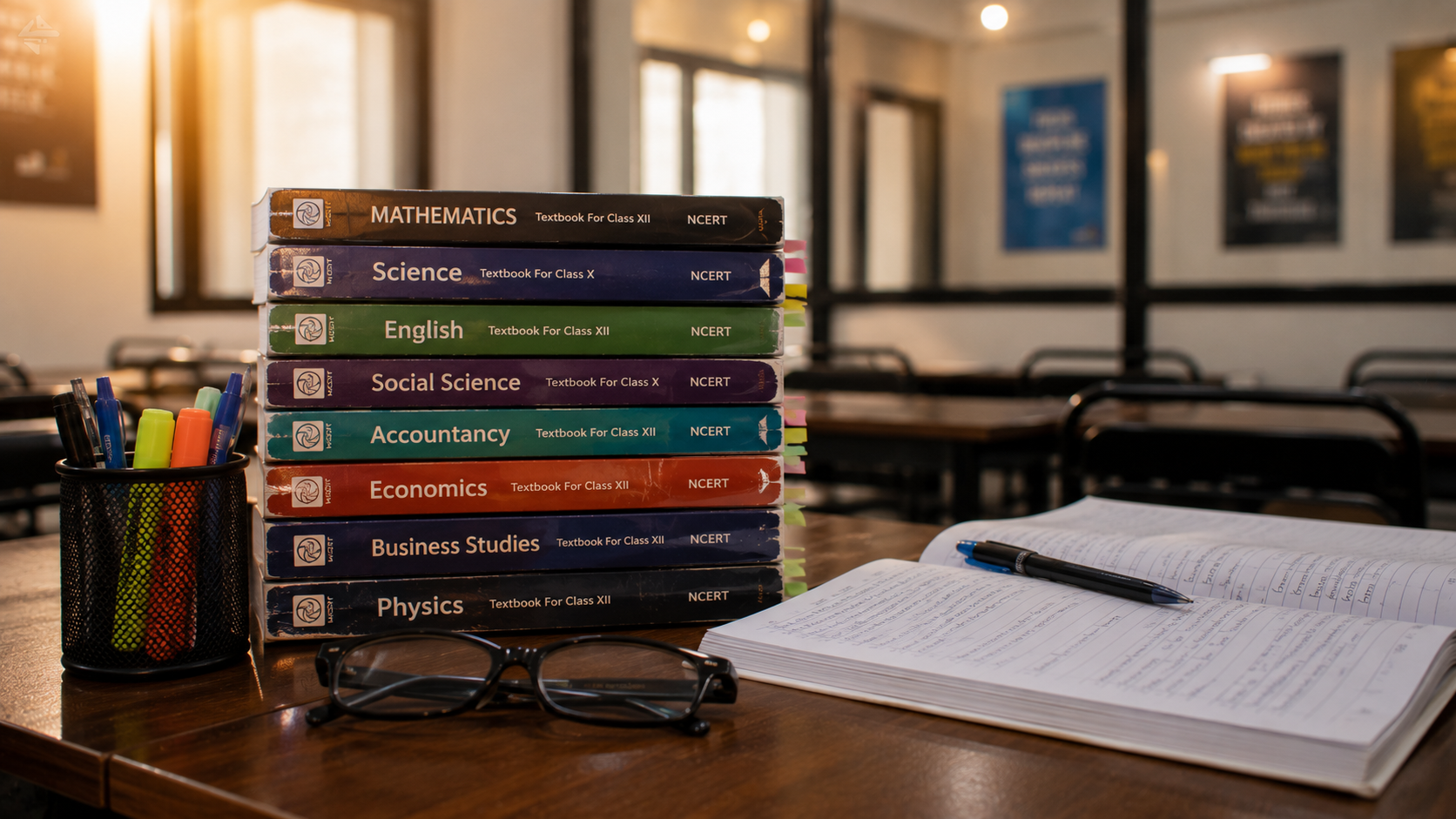
Class 11 and 12 Commerce subjects (Accountancy, Business Studies, Economics, Applied Mathematics) each have an 80-mark board paper and a 20-mark internal assessment component. The structure at Class 11–12 differs from Class 9–10:
Project work
Most Class 11–12 Commerce subjects require project work as part of internal assessment. Accountancy requires a project on financial statement analysis or special topics like GST. Business Studies has a project on forms of business or marketing. Economics has a project on an economic problem or index number analysis. Applied Mathematics involves statistics or mathematics-application projects.
Projects are typically due in the final term and are evaluated by the school teacher. Students who start their project in October–November and work consistently have well-researched, well-presented projects. Students who start in January have rushed work that reflects that.
Periodic assessment
Class 11–12 periodic tests are similar in structure to Class 9–10 but cover larger portions of the syllabus. The questions in Class 12 periodic tests often come from the same chapter pool as board exam questions — making them dual-purpose revision tools when taken seriously.
Why Internal Assessment Matters More Than Students Think
The most common internal assessment mistake: students treat the 20 marks as automatic and focus entirely on the 80-mark board paper. This is a mathematical error. Here is why internal assessment marks matter strategically:
The cushion effect
A student with 19/20 in internal assessment needs only 33/80 on the board paper to reach 52% in that subject. A student with 12/20 needs 40/80 to reach the same 52%. The higher your internal assessment score, the lower the board exam bar you need to clear. In subjects where students are genuinely uncertain about their board performance, strong internal assessment marks are a safety net.
No recovery mechanism
Board exam performance can be partially recovered through compartment exams. Internal assessment marks, once set by the school, are submitted to CBSE and typically cannot be revised. A student who is careless about a periodic test in July has no recovery mechanism for those marks by March.
The notebook and attendance effect
Notebook submission and enrichment activity marks are almost entirely within the student's control — they require organisation and consistency, not examination talent. Students who maintain complete, neat notebooks and participate in activities consistently score 8–9/10 on these components without any special preparation. Students who are careless often score 4–5/10, losing marks that required no exam performance at all.
Frequently Asked Questions
Found this useful? Share it.