Strong performance in CBSE Class 10 Mathematics is a goal many students set — and it is entirely within reach with the right approach. The key insight is that CBSE Class 10 Maths is not a random collection of problems. It follows patterns, favours specific question types by chapter, and rewards students who practice systematically over those who study randomly. This guide breaks down the chapter-by-chapter strategy that makes it work.
The Four Categories of Class 10 Maths Chapters
Before diving into chapter-by-chapter strategy, it helps to categorise all 15 Class 10 chapters by their typical contribution to the Board paper and by their relative difficulty.
- High marks + High frequency: Trigonometry, Arithmetic Progressions, Quadratic Equations, Coordinate Geometry, Areas Related to Circles, and Statistics/Probability. These chapters appear consistently for 3-mark and 5-mark questions and offer the best marks-per-study-time ratio.
- High marks + Moderate difficulty: Surface Areas and Volumes, Triangles. These chapters have large-weight questions but require methodical practice to score well.
- Moderate marks + Foundation critical: Real Numbers, Polynomials, Linear Equations in Two Variables. These are shorter chapters but conceptually important — weaknesses here appear in later questions.
- Can be mastered quickly: Constructions, Circles (theorems). These chapters have predictable question types and can be thoroughly prepared in relatively short time.
Chapter-by-Chapter Key Points
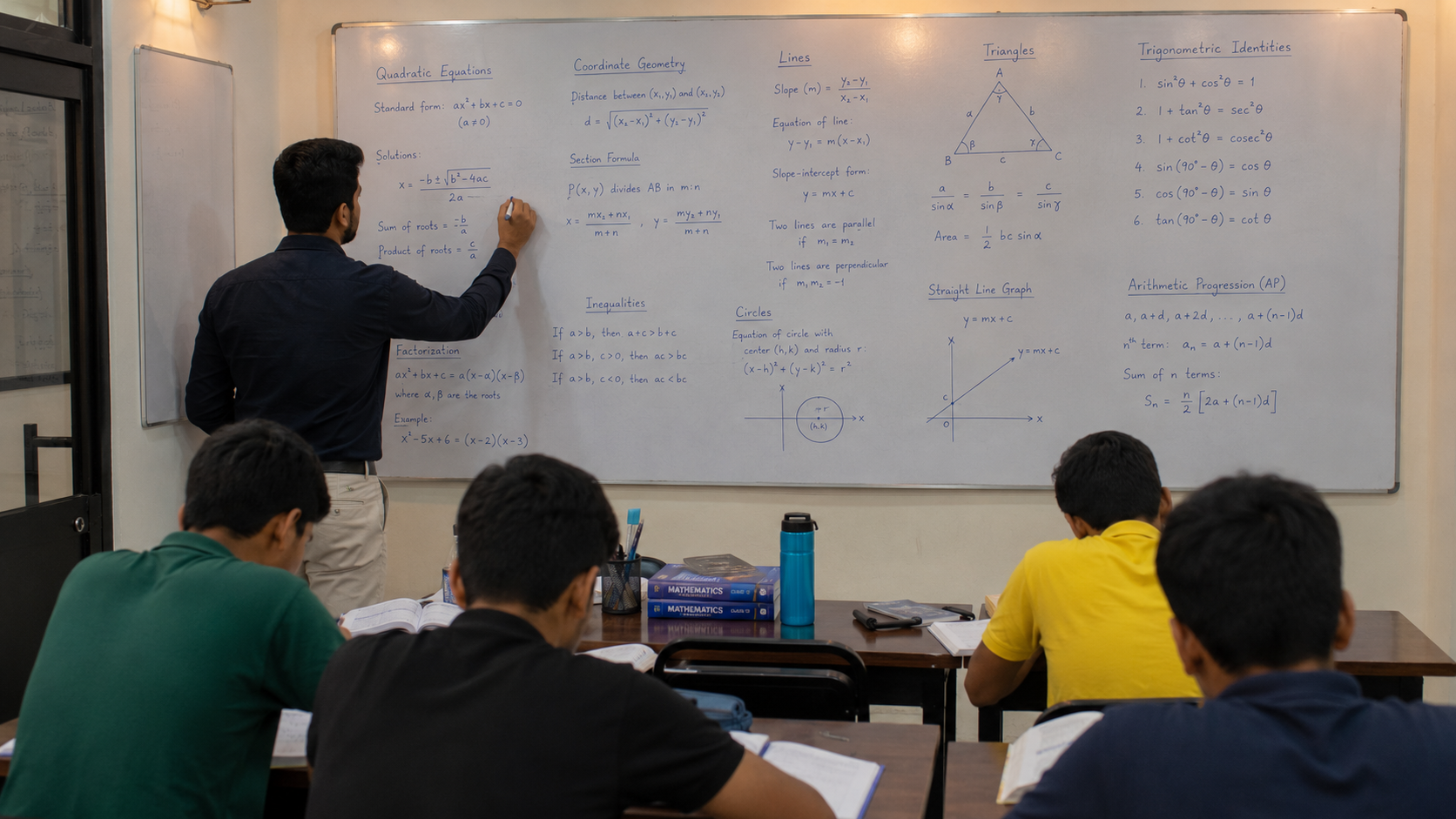
Real Numbers: Understand Euclid's Division Algorithm, HCF/LCM methods, and irrationality proofs. These have predictable 3-mark problems.
Polynomials: Master the relationship between zeroes and coefficients. Practise division algorithm problems.
Linear Equations: Focus on graphical method and cross-multiplication method. Word problems are common in 3-mark questions.
Quadratic Equations: Practice all four methods — factorisation, completing square, formula, and graphical. Word problems from this chapter appear in 5-mark questions.
Arithmetic Progressions: Know all formulae (nth term, sum of n terms) and their variations. This chapter has extremely predictable questions in CBSE papers.
Trigonometry: Memorise all standard values and identities. Proving identities and elevation/depression problems are the highest-scoring question types.
Coordinate Geometry: Master section formula, distance formula, and area of triangles. These have predictable 3-mark applications.
Statistics: Practice Mean (direct, assumed mean, step deviation), Median (graphical and formula), and Mode. All three are tested in every Board paper.
The Practice Discipline That Makes the Difference
Students who do consistently well in Class 10 Maths have typically solved each type of CBSE question at least 5 to 7 times before the Board exam. This is not memorisation — it is pattern recognition. After solving a Trigonometry proof problem seven times in different forms, you develop an intuitive sense of which identity to apply, which is what separates confident answers from hesitant ones.
How to Prepare for the CBSE Class 10 Maths Board Exam
CBSE students in Dwarka and across Delhi can follow this structured preparation framework:
- Complete every NCERT exercise for all 15 chapters — without skipping a single problem.
- Solve NCERT Exemplar problems for additional depth and harder question variations.
- Use one quality practice book (R.D. Sharma or R.S. Aggarwal) for drilling problem-solving fluency.
- Practice CBSE previous year papers for the last five years — identifying patterns in question types.
- In the final two months, solve at least two full-length timed papers per week under exam conditions.
Frequently Asked Questions
Found this useful? Share it.